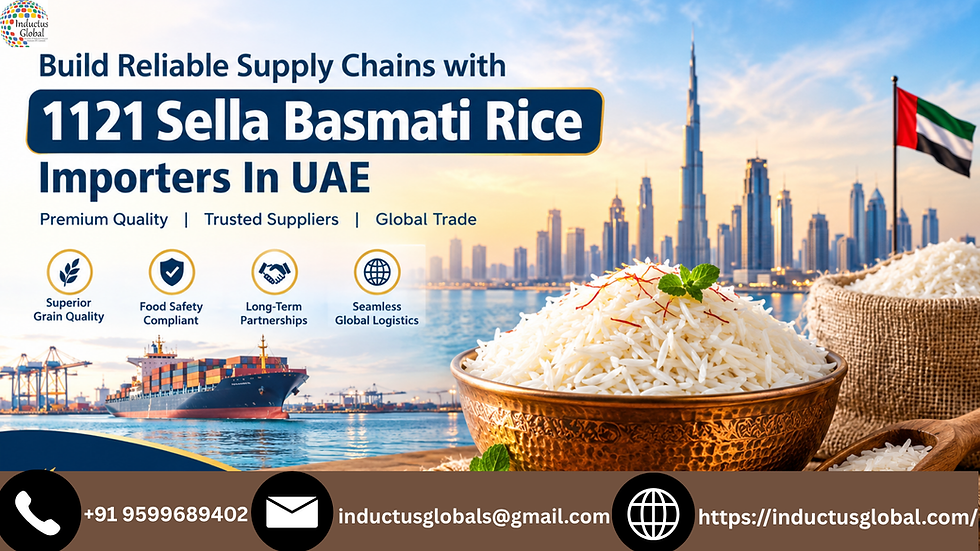
Build Reliable Supply Chains with 1121 Sella Basmati Rice Importers In UAE

Introduction
The UAE has developed into an important hub for rice trading, food distribution, and re-export across the Middle East. Within this market, 1121 Sella Basmati Rice Importers In UAE play an important role in connecting international suppliers with wholesalers, retailers, food-service companies, and distributors. Known for its long grains, aromatic characteristics, and suitability for large-scale food preparation, 1121 Sella Basmati rice is widely traded in international markets. For exporters and global buyers, selecting reliable import partners involves more than comparing prices. Product specifications, milling quality, packaging, documentation, shipping schedules, food-safety compliance, and supply consistency all influence the success of a rice supply chain.
India’s Position in the Global Basmati Rice Market
India is one of the world's major suppliers of basmati rice, with established production, milling, processing, packaging, and export networks. Indian basmati varieties are shipped to markets across the Middle East, Europe, North America, Africa, and Asia.
The UAE is particularly significant because of its strong food-import infrastructure and strategic location. Dubai and other commercial centres provide access to established ports, warehouses, distributors, and re-export channels. For UAE buyers, sourcing from established Indian rice exporters can provide access to different grades, packaging formats, and shipment volumes. At the same time, Non Basmati Rice Suppliers in UAE serve another important segment by supplying economical rice varieties for restaurants, institutional buyers, food processors, and mass-market consumption.
Understanding 1121 Sella Basmati Rice
1121 is a widely traded extra-long-grain basmati variety. The term Sella generally refers to parboiled processing, in which paddy undergoes controlled soaking, heating, and drying before milling. This process can improve grain strength and cooking characteristics. The product is commonly evaluated based on:
Grain length and appearance
Moisture level
Broken-grain percentage
Foreign matter
Aroma and cooking characteristics
Milling quality
Packaging specifications
Parboiling and processing standards
These specifications should be agreed upon before a commercial shipment is finalized.
1121 Sella Basmati Rice Importers In UAE and Their Supply-Chain Role
1121 Sella Basmati Rice Importers In UAE operate at an important point between international exporters and the domestic or regional food market. They may purchase rice in bulk, arrange local warehousing, distribute products to wholesalers, or supply restaurants and retail chains. A dependable rice supply chain normally involves several stages: farmer or paddy procurement, milling, grading, quality inspection, packaging, export documentation, ocean freight, customs clearance, warehousing, and final distribution. For B2B buyers, coordination between these stages can reduce delays and quality inconsistencies. Importers can also help suppliers understand local market requirements, preferred packaging sizes, and purchasing patterns.
Key Product Categories and Rice Segments
The UAE rice market includes both premium and value-oriented segments. While 1121 Sella Basmati is positioned toward premium and speciality rice demand, other varieties are also important.
1.Basmati Rice
Basmati rice includes several varieties and processing formats, including traditional basmati, 1121, steam basmati, white basmati, and parboiled or Sella basmati. Buyers select products according to grain characteristics, cooking requirements, price points, and target consumers.
2.Non-Basmati Rice
Non Basmati Rice Suppliers in UAE support buyers looking for cost-effective alternatives to premium basmati. Varieties such as IR64, Sona Masoori, Swarna, and other long- or medium-grain rice products can serve different commercial applications.
3.Bulk and Private-Label Rice
Large distributors and supermarket groups may require bulk shipments or private-label packaging. In these cases, suppliers need to meet agreed specifications for bag sizes, branding, labelling, quality parameters, and shipment quantities.
Export Performance and Estimated Market Indicators
India's rice industry benefits from large-scale agricultural production and a mature export ecosystem. However, export volumes and values fluctuate according to production levels, government policies, international prices, freight costs, exchange rates, and destination-market demand. The following figures are illustrative industry estimates rather than official statistics and should be used only for general market understanding.
Market Indicator | Estimated Range / Observation |
Major Indian rice export markets | Middle East, Africa, Asia, Europe, North America |
Common commercial shipment size | 20–25 metric tonnes per container, depending on packing and logistics |
Popular Basmati segment | 1121, traditional and other premium varieties |
Common Basmati packaging | 5 kg, 10 kg, 20 kg, 25 kg and bulk formats |
UAE market role | Domestic consumption, wholesale distribution and regional re-export |
Key purchasing factors | Quality, price, specifications, documentation and delivery reliability |
Actual shipment specifications should always be confirmed between the buyer, exporter, logistics provider, and relevant authorities.
Major Export Destinations and UAE Demand
The Middle East remains an important destination for Indian rice. The UAE's developed logistics infrastructure also enables products to move beyond its domestic market into neighbouring countries and wider regional markets. Other important destinations for Indian rice include Saudi Arabia, Iraq, Iran, Kuwait, Qatar, Oman, the United Kingdom, United States, Canada, and several African markets. For UAE importers, demand can come from supermarkets, wholesale distributors, restaurants, caterers, hotels, food-service operators, and trading companies. This creates opportunities for suppliers that can maintain consistent specifications over repeated shipments.
Strengths of Indian Rice Exports
1.Competitive Production Ecosystem
India has a large agricultural base and an extensive rice-processing industry. This allows international buyers to source different varieties and grades according to their requirements.
2.Established Milling Infrastructure
Modern rice mills use sorting, grading, polishing, packaging, and quality-control technologies. These facilities help exporters produce commercially consistent shipments.
3.Skilled Workforce
The Indian rice industry has experienced professionals across farming, milling, quality inspection, packaging, logistics, and international trade.
4.Strong Logistics Network
Major ports, container facilities, inland transportation networks, warehouses, and freight-forwarding services support rice exports from India to international destinations.
5.Product Variety
Indian suppliers can offer both premium basmati and economical non-basmati varieties. This gives distributors flexibility when serving different consumer segments.
Industry Challenges
Despite its strong position, the rice trade faces several challenges. International commodity prices can change rapidly because of weather conditions, crop availability, freight costs, currency movements, and government policies. Exporters and importers must also pay close attention to food-safety requirements. Product documentation, labelling, certificates, quality specifications, phytosanitary requirements, and customs procedures can differ by destination. Competition is another important consideration. Rice exporters from countries such as Pakistan, Thailand, Vietnam, and other producing regions compete across different market segments. For 1121 Sella Basmati Rice Importers In UAE, maintaining a balance between quality, landed cost, inventory levels, and delivery schedules is therefore essential.
Sustainability and Future Outlook
Sustainability is becoming increasingly important throughout the international food-supply chain. Rice businesses are exploring better water management, efficient milling technologies, responsible packaging, energy-efficient processing, and improved transportation planning. The future of the UAE rice market is likely to be influenced by population growth, food-service expansion, retail development, regional re-export activity, and changing consumer preferences. Digital procurement systems may also improve supplier evaluation and shipment tracking. Buyers can increasingly compare specifications, certifications, pricing, lead times, and logistics information before selecting an international supplier. For exporters, building long-term relationships with UAE importers rather than focusing exclusively on individual transactions can contribute to more predictable supply chains.
FAQs
1.Who are 1121 Sella Basmati Rice Importers In UAE?
They are UAE-based businesses that import 1121 Sella Basmati rice from international suppliers, including Indian exporters, for wholesale distribution, retail, food service, processing, or regional trade.
2.Why is 1121 Sella Basmati Rice popular?
Its extra-long grain characteristics, cooking performance, appearance, and suitability for various rice-based dishes make it an important product in premium and commercial rice markets.
3.Are there Non Basmati Rice Suppliers in UAE?
Yes. Non Basmati Rice Suppliers in UAE serve customers seeking economical rice varieties for restaurants, catering businesses, institutional consumption, wholesalers, and other commercial applications.
4.What should UAE buyers check before importing rice?
Buyers should evaluate grain specifications, moisture, broken percentage, packaging, certificates, food-safety requirements, supplier reliability, shipment terms, and total landed cost.
5.Why source basmati rice from India?
India has a large rice-processing ecosystem, established export infrastructure, extensive product availability, and experience supplying international markets.
6.Is 1121 Sella Basmati Rice suitable for bulk procurement?
Yes. It is commonly traded in commercial quantities, making it suitable for wholesalers, distributors, food-service businesses, retailers, and other institutional buyers when the product specifications match their requirements.
Conclusion
The UAE's strategic location and developed food-trading infrastructure make it an important market for international rice businesses. Indian exporters can serve this market through different basmati and non-basmati varieties, while UAE distributors can use established supply networks to serve domestic and regional customers. For businesses seeking dependable procurement, product quality, appropriate documentation, competitive landed costs, and consistent delivery should remain central considerations. Working with experienced 1121 Sella Basmati Rice Importers In UAE can help businesses build more organized and reliable international rice supply chains while responding to changing market requirements.



Comments