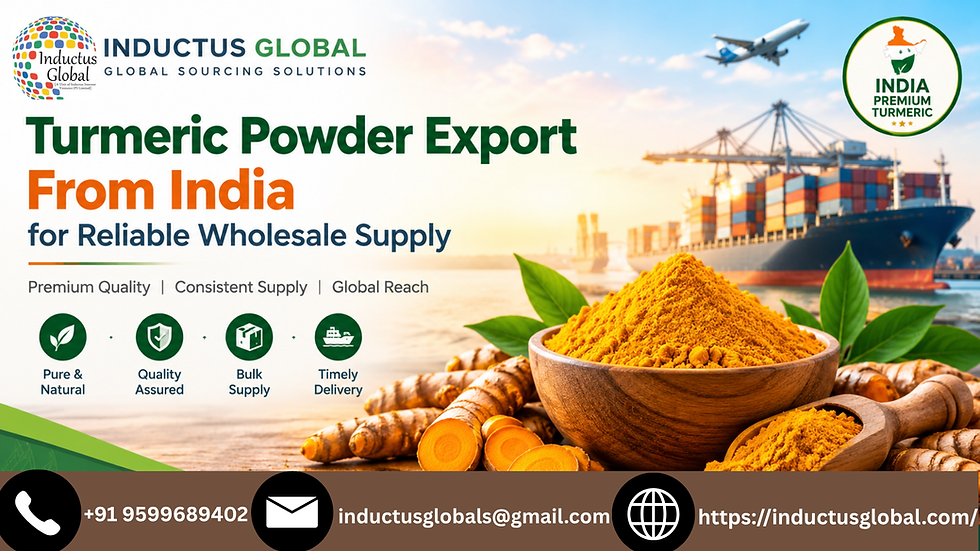
Turmeric Powder Export From India for Reliable Wholesale Supply

Introduction
Turmeric Powder export From India has become an important part of India’s spice trade, supplying food manufacturers, wholesalers, retailers, restaurants, and distributors across international markets. Turmeric is valued for its distinctive colour, earthy flavour, and widespread use in culinary, food-processing, nutraceutical, and traditional applications. India has a strong position in turmeric cultivation and processing, supported by established agricultural regions, processing facilities, experienced spice traders, and export infrastructure. For international buyers, sourcing turmeric powder from India can provide access to different grades, packaging formats, and supply volumes suited to wholesale requirements. As global demand for natural spices continues to develop, quality control, traceability, food safety, and consistent supply are becoming increasingly important factors in international turmeric procurement.
India’s Position in the Global Turmeric Market
India is one of the world's leading producers and exporters of turmeric and turmeric-based products. Turmeric cultivation is concentrated in several Indian states, including Telangana, Maharashtra, Karnataka, Tamil Nadu, Andhra Pradesh, and Odisha.
Indian turmeric is processed into several commercial forms, including whole dried turmeric fingers, turmeric powder, turmeric extracts, and value-added spice products. This broad production base allows exporters and sourcing companies to serve buyers with different specifications. For international procurement teams, Turmeric Powder export From India can involve several stages, from farmer and processor sourcing to cleaning, grinding, testing, packaging, documentation, and shipment. The supply chain also supports Retail Sourcing, particularly for businesses purchasing packaged spices or developing private-label products for supermarkets and specialty food stores.
Turmeric Powder Export From India: Key Product Categories and Segments
International buyers can source turmeric powder in different grades depending on their intended application. Product specifications may vary according to colour value, moisture content, particle size, aroma, processing method, and microbiological requirements.
1.Standard Turmeric Powder
Standard turmeric powder is commonly used by wholesalers, food manufacturers, restaurants, and spice distributors. It is generally supplied in bulk packaging according to buyer requirements.
2.High-Colour Turmeric Powder
High-colour varieties are selected when stronger natural colouring properties are important. Food manufacturers and spice blenders may specify colour values when purchasing commercial quantities.
3.Organic Turmeric Powder
Organic turmeric powder is produced according to applicable organic farming and certification requirements. It can be relevant to buyers targeting natural and organic food markets.
4.Industrial and Food-Processing Grades
Large food-processing companies may require turmeric powder with specific technical specifications, testing procedures, packaging standards, and documentation. Buyers should establish these requirements before placing bulk orders.
Export Performance and Statistics
India's turmeric sector benefits from substantial domestic production and an established international trade network. Export volumes and values can vary from year to year because of crop conditions, domestic prices, currency movements, freight costs, and international demand. The following figures are illustrative estimates for market understanding rather than official trade statistics:
Market Indicator | Estimated/Illustrative Range |
India’s share of global turmeric production | 70–80% |
Major production regions | 6+ key states |
Typical wholesale shipment sizes | 1–25+ metric tonnes |
Common bulk packaging | 25 kg, 50 kg and larger bags |
Major buyer segments | Food, retail, hospitality and processing |
Common export destinations | Middle East, North America, Europe, Asia |
Actual export statistics should be verified through current government trade data, customs records, and recognized international trade databases before being used for commercial or investment decisions.
Major Export Destinations for Indian Turmeric Powder
Indian turmeric products reach a diverse range of international markets. Demand is influenced by food consumption patterns, ethnic cuisine, spice-processing industries, health-food trends, and the growth of packaged food.
1.Middle East
Countries in the Middle East represent important markets for Indian spices. Turmeric powder is used by households, restaurants, food processors, and spice distributors.
2.North America
The United States and Canada have established demand for Indian spices through food manufacturers, wholesalers, restaurants, and specialty grocery channels. Buyers may place greater emphasis on testing, labelling, food safety, and traceability.
3.Europe
European markets can offer opportunities for turmeric suppliers, particularly in packaged foods, spice blends, natural-food products, and ethnic-food distribution. Importers must comply with relevant European food safety and labelling requirements.
4.Asia-Pacific
Asian markets also provide opportunities due to strong culinary demand for turmeric. Requirements can differ considerably between countries, making local regulations and buyer specifications important considerations.
Strengths of Indian Turmeric Exports
Several factors contribute to India's competitiveness in the international turmeric market.
1.Large agricultural base: India has extensive turmeric cultivation and an established network of growers and agricultural markets.
2.Processing expertise: Indian processors have experience in cleaning, drying, grinding, blending, and packaging spices for domestic and international buyers.
3.Competitive sourcing: A developed agricultural and processing ecosystem can support competitive procurement costs, although prices vary according to crop conditions and market demand.
4.Skilled workforce: Experience across farming, processing, quality inspection, packaging, logistics, and export documentation supports the broader spice supply chain.
5.Export infrastructure: Major ports, logistics providers, freight forwarders, testing laboratories, and customs services support international shipment operations.
For companies involved in Retail Sourcing, these capabilities can be particularly useful when developing private-label spice products or maintaining regular wholesale inventory.
Industry Challenges
Despite its strong position, the Indian turmeric export industry faces several challenges.
1.Quality and Food Safety
International buyers increasingly require laboratory testing for microbiological parameters, contaminants, pesticide residues, heavy metals, moisture, and other specifications. Meeting buyer-specific requirements consistently is essential.
2.Price Volatility
Turmeric prices can change because of weather conditions, crop yields, domestic demand, storage levels, transportation expenses, and international market conditions. Long-term procurement planning can therefore be challenging.
3.Regulatory Compliance
Exporters must comply with Indian export procedures as well as the import regulations of the destination country. Labelling, certificates, documentation, packaging, and permitted contaminant levels may vary between markets.
4.International Competition
India competes with other turmeric-producing countries. Buyers may compare suppliers based on quality consistency, specifications, delivery schedules, certifications, packaging, and total landed cost rather than product price alone.
Sustainability and Future Outlook
Sustainability is becoming increasingly relevant to the global spice industry. Buyers are paying greater attention to responsible agricultural practices, efficient water use, reduced waste, environmentally conscious packaging, and traceable supply chains.
Turmeric processing can also create opportunities for better utilization of agricultural by-products and improvements in energy efficiency. Modern processing facilities may adopt improved drying, grinding, packaging, and quality-monitoring systems to reduce waste and improve consistency. The future outlook for Indian turmeric exports remains closely connected to international demand for spices, packaged foods, natural ingredients, and ready-to-use culinary products. Digital procurement platforms and improved supply-chain visibility may also make it easier for international buyers to compare suppliers and manage recurring orders. For businesses engaged in wholesale procurement and Retail Sourcing, product consistency, documentation, traceability, and reliable logistics are likely to remain important purchasing criteria.
FAQs About Turmeric Powder Export From India
1.Why is Indian turmeric popular in international markets?
Indian turmeric is widely used because of its distinctive colour, flavour, established production base, and availability in different commercial grades.
2.What should buyers check before importing turmeric powder?
Buyers should review product specifications, colour value, moisture, microbiological parameters, pesticide-residue requirements, certifications, packaging, shelf life, documentation, and applicable destination-country regulations.
3.Can turmeric powder be purchased in bulk from India?
Yes. Indian suppliers and exporters can serve wholesale and industrial buyers with different shipment sizes and packaging formats, subject to supplier capabilities and buyer specifications.
4.Which industries use imported turmeric powder?
Major users include food manufacturers, spice blenders, restaurants, wholesalers, retailers, distributors, and companies involved in packaged and ethnic foods.
5.Is turmeric powder suitable for Retail Sourcing?
Yes. Turmeric powder is commonly included in retail spice portfolios. Retail buyers should pay particular attention to packaging, labelling, shelf life, certifications, product consistency, and applicable retail-market regulations.
6.What affects the price of Indian turmeric powder?
Pricing can depend on turmeric variety, colour value, quality grade, processing, order volume, packaging, certifications, seasonality, freight costs, exchange rates, and destination-market requirements.
Conclusion
India's established agricultural base, processing capabilities, skilled workforce, and international spice-trading network make it an important source for global turmeric buyers. However, successful procurement requires more than comparing prices. Buyers should evaluate product specifications, testing, regulatory compliance, documentation, packaging, logistics, and consistency of supply. For wholesalers, food manufacturers, distributors, and businesses involved in Retail Sourcing, understanding these factors can support better purchasing decisions and more resilient supply chains. With careful supplier evaluation and appropriate quality controls, Turmeric Powder export From India can continue to serve diverse international markets and evolving global spice demand.


Comments