Top Non Basmati Rice Suppliers in UAE for Wholesale and Bulk Buyers

Introduction
The UAE is one of the Middle East’s most important food-trading and distribution hubs, with strong demand for rice from wholesalers, retailers, restaurants, food processors, and institutional buyers. Non Basmati Rice Suppliers in UAE serve a broad market that requires consistent quality, competitive pricing, reliable volumes, and efficient delivery.
Non-basmati rice is particularly important because it offers buyers a wider range of grain varieties and price points than premium basmati rice. For international businesses, sourcing decisions often depend on grain specifications, origin, milling quality, packaging, order volume, and compliance requirements. India remains an important source of rice for international markets, while the UAE functions as both a major consumption market and a regional re-export centre.

India’s Position in the Global Rice Market
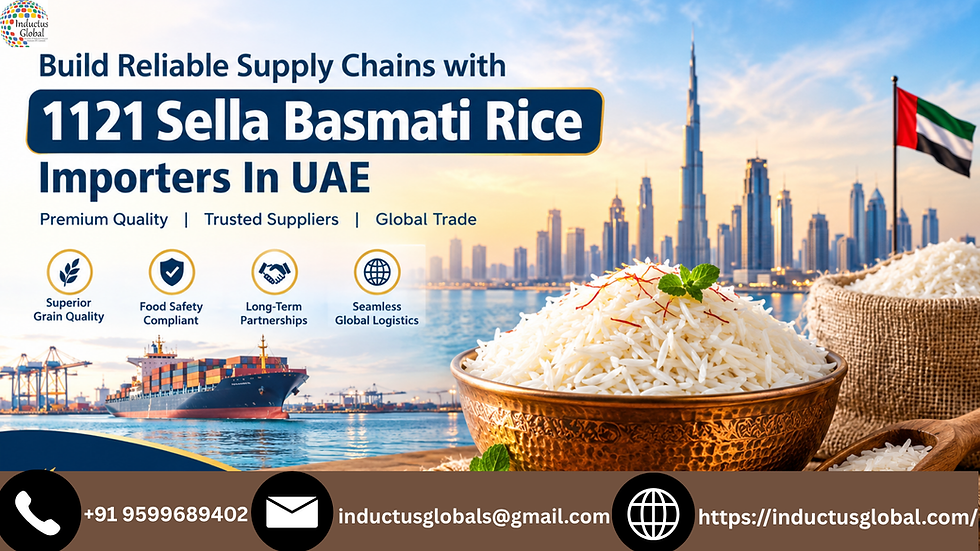
India is one of the world's leading rice-producing and rice-exporting countries, supported by extensive cultivation areas, established milling infrastructure, experienced exporters, and access to major international shipping routes. Indian rice is supplied to markets across the Middle East, Africa, Asia, Europe, and North America. For UAE buyers, Indian suppliers can provide several rice categories according to market requirements. While 1121 Sella Basmati Rice Importers In UAE focus primarily on the premium basmati segment, non-basmati rice serves a broader range of wholesale and everyday-consumption applications. The UAE's geographic position also makes it an important gateway for food distribution across the Gulf and nearby markets. Buyers therefore often evaluate suppliers not only on product quality but also on their ability to maintain regular supply and meet documentation and shipment requirements.
Major Categories Offered by Non Basmati Rice Suppliers in UAE
The non-basmati segment includes several varieties that differ in grain length, texture, aroma, cooking characteristics, and price.
1.IR64 Long Grain Rice
IR64 is widely traded internationally and is commonly used for everyday meals, catering, food-service applications, and institutional procurement. Its relatively competitive pricing makes it suitable for bulk purchasing.
2.Parboiled Non-Basmati Rice
Parboiled rice is processed before milling, which can improve grain durability and reduce breakage during cooking. It is frequently used in commercial food preparation and large-volume procurement.
3.Long Grain Non-Basmati Rice
Long-grain varieties are popular among wholesalers and retailers looking for an economical rice product with attractive cooking characteristics.
4.Broken Rice
Broken rice is generally positioned as a more economical segment and can be used in food processing, institutional kitchens, and other applications where whole-grain appearance is less important.
5.Specialty and Regional Varieties
Depending on the supplier and origin, buyers may also find additional non-basmati varieties suited to specific regional cuisines and food-service requirements.
Export Performance and Estimated Market Indicators
India's rice export sector operates at substantial scale, with non-basmati rice contributing significantly to overall international trade. The following figures are indicative estimates rather than official current-year statistics and are provided to illustrate the scale and commercial structure of the sector.
Indicator | Estimated/Indicative Range | Relevance to Buyers |
India's annual rice production | 140–150+ million tonnes | Large domestic production base |
Annual rice exports | 15–25+ million tonnes | Strong international supply capacity |
Non-basmati share | Varies considerably by year | Significant volume segment |
Major importing regions | Middle East, Africa, Asia | Diverse demand base |
Common commercial shipments | Container and bulk consignments | Suitable for wholesale procurement |
Key purchasing factors | Price, grade, moisture, broken %, packaging | Determines landed cost and usability |
Actual export volumes can change substantially because of crop conditions, domestic supply, government policies, export regulations, and international market prices.
Major Export Destinations and Global Demand
Indian non-basmati rice reaches numerous international markets. Countries across Africa and the Middle East represent important destinations, while demand also exists in Asian and other global markets. The Middle East has a particularly strong rice-consuming population, supported by both local consumption and food-service industries. The UAE's role as a logistics and distribution hub further increases its importance for regional food trade. For wholesalers, selecting a supplier involves evaluating more than the quoted rice price. Freight rates, insurance, customs duties, port charges, packaging specifications, and delivery schedules can significantly influence the final landed cost. Businesses also sourcing premium varieties may compare non-basmati options with products handled by 1121 Sella Basmati Rice Importers In UAE, particularly when deciding which rice category best matches their target customers.
Strengths of Indian Rice Exports
1.Competitive Production Economics
India has a large agricultural base and established rice-processing ecosystem. Large-scale cultivation and milling capabilities can support competitive pricing for international buyers.
2.Diverse Product Portfolio
Indian suppliers can offer multiple rice varieties, allowing buyers to select products based on grain length, processing method, cooking characteristics, and target market.
3.Established Milling Infrastructure
Modern rice mills use grading, sorting, polishing, packaging, and quality-control processes to prepare rice for different international specifications.
4.Experienced Export Ecosystem
India has an established network of farmers, millers, traders, exporters, freight providers, inspection agencies, and logistics companies supporting international rice shipments.
5.Strong Logistics Connectivity
Major ports and established shipping routes connect Indian suppliers with the UAE and other international markets. This infrastructure is particularly important for regular wholesale procurement.
Challenges for Buyers and Suppliers
Despite strong production capacity, the rice trade faces several challenges.
1.Government policies can affect export availability and pricing. Changes in export restrictions, duties, minimum prices, or domestic food-security measures can influence international transactions.
2.Price volatility is another concern. Crop yields, weather conditions, freight costs, currency movements, and global demand can all affect procurement prices.
3.Quality consistency is also important. Buyers should specify parameters such as grain length, moisture level, broken percentage, foreign matter, milling degree, packaging requirements, and applicable food-safety standards before placing large orders.
Competition among international rice-producing countries can also affect market positioning. Suppliers therefore need to maintain consistent quality and efficient supply chains rather than competing solely on price.
Sustainability and Future Outlook
Sustainability is becoming increasingly relevant throughout the global rice industry. Rice cultivation can require substantial quantities of water, while processing and transportation contribute to the environmental footprint of the supply chain. Future opportunities include improved water-management practices, efficient milling technologies, renewable-energy adoption, recyclable packaging, reduced processing waste, and better supply-chain traceability. Digital procurement platforms and improved logistics visibility may also make international sourcing more transparent. UAE buyers can increasingly evaluate suppliers based on documentation, product specifications, traceability, shipment performance, and sustainability practices alongside traditional price considerations. The long-term outlook for rice trade remains closely connected to population growth, urbanisation, food-service demand, and changing consumer preferences across emerging markets.
FAQs
1. What should buyers look for in Non Basmati Rice Suppliers in UAE?
Buyers should evaluate product specifications, consistency, pricing, packaging options, food-safety documentation, supply capacity, delivery timelines, and experience with wholesale or bulk orders.
2. Is non-basmati rice suitable for bulk procurement?
Yes. Non-basmati rice is widely used for wholesale distribution, restaurants, catering, institutional procurement, food processing, and retail markets. Its comparatively broad price range makes it suitable for different buyer segments.
3. How does non-basmati rice differ from basmati rice?
Basmati rice is generally recognised for its distinctive aroma, long grains, and characteristic cooking properties. Non-basmati rice covers a much broader group of varieties with different grain characteristics, applications, and price points.
4. What are 1121 Sella Basmati Rice Importers In UAE looking for?
Importers of 1121 Sella typically focus on grain length, appearance, processing quality, moisture, broken percentage, packaging, consistency, and compliance with destination-market requirements.
5. Can Indian rice suppliers support UAE wholesale buyers?
Indian rice exporters and suppliers can serve international wholesale markets with different varieties and shipment sizes. Buyers should verify the supplier's current export capability, product specifications, certifications, and commercial terms before ordering.
6. What documents are commonly required for rice imports?
Depending on the transaction and destination requirements, documentation may include commercial invoices, packing lists, certificates of origin, shipping documents, health or phytosanitary certificates, and other regulatory documentation. Requirements should be confirmed with the relevant UAE authorities and the buyer's customs or compliance team.
Conclusion
The UAE's position as a major food-importing and distribution market creates sustained opportunities for rice wholesalers and bulk buyers. Indian rice benefits from large-scale production, diverse varieties, established processing infrastructure, and extensive international trade experience. For buyers evaluating Non Basmati Rice Suppliers in UAE, the best procurement decisions should consider quality specifications, pricing, documentation, logistics, supply consistency, and long-term market requirements rather than price alone. As international rice trade becomes more quality- and sustainability-focused, reliable sourcing practices will remain important for building efficient and resilient food supply chains.
Comments