Powering Responsible Retail Through Sustainable Sourcing

Introduction
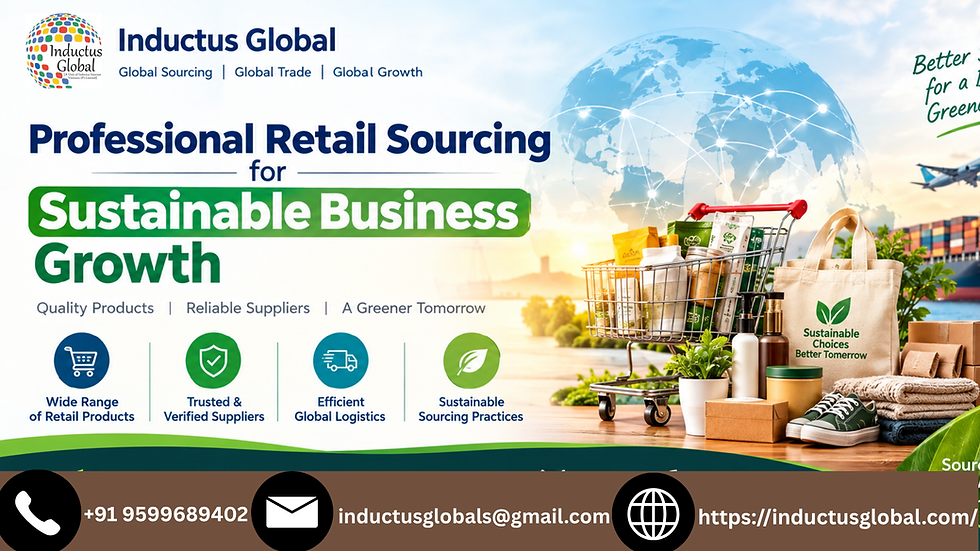
Retails Sustainable Sourcing is becoming increasingly important as retailers, importers, wholesalers, and global buyers look beyond price and availability when selecting products and suppliers. Responsible sourcing considers environmental impact, ethical production, supplier transparency, product quality, and long-term supply-chain resilience. For international retailers, sustainable sourcing can help create more responsible procurement systems while supporting cost control and consistent product availability. From raw materials and packaging to finished consumer goods, buyers are increasingly evaluating how products are manufactured, transported, packaged, and supplied. India has an important role in this evolving global sourcing landscape. Its diverse manufacturing base, agricultural resources, skilled workforce, and growing export infrastructure make it a significant sourcing destination for international businesses.

Retails Sustainable Sourcing and India’s Position in the Global Market
India is one of the world's major trading economies, supplying agricultural products, textiles, handicrafts, chemicals, engineering goods, pharmaceuticals, processed foods, and numerous consumer products to international markets. The country's large supplier ecosystem provides retailers with access to different manufacturing capabilities and product categories. This is particularly relevant for businesses looking to diversify their supply chains and reduce excessive dependence on a single sourcing region. Product Sourcing Companies In UK and international procurement teams can work with Indian suppliers across multiple categories, depending on product specifications,certifications, order volumes, and destination-market requirements. Sustainable procurement is also changing how international buyers assess Indian suppliers. Instead of considering only purchase price, businesses increasingly examine material sourcing, production processes, packaging, waste management, labor practices, certifications, and logistics efficiency.
Key Product Categories for Sustainable Retail Sourcing
Retail sourcing covers a wide range of products, and sustainability considerations vary according to each category.
1.Textiles and apparel are important sourcing segments where buyers may evaluate recycled fibers, organic materials, responsible manufacturing, water consumption, and production waste.
2.Handicrafts and home décor can provide opportunities for sourcing products made from natural, recycled, or renewable materials. Wooden products, bamboo goods, jute products, metal crafts, and other traditional products are relevant to sustainable retail collections when their materials and production practices meet buyer requirements.
3.Food and agricultural products represent another major segment. Spices, rice, pulses, oilseeds, fruits, vegetables, and processed foods are supplied to international markets. Buyers need to consider food safety, traceability, packaging, certifications, and responsible agricultural practices.
4.Packaging products are increasingly important because retailers are seeking alternatives to excessive single-use plastics. Recyclable paper packaging, reusable materials, biodegradable alternatives, and lightweight packaging can contribute to more resource-efficient supply chains.
5.Engineering and consumer products also form part of the sourcing landscape. For these categories, sustainability can involve material efficiency, product durability, energy consumption, recyclability, and responsible manufacturing.
Export Performance and Estimated Market Indicators
India's merchandise exports span thousands of products and numerous destination markets. Because export values change annually according to commodity prices, global demand, exchange rates, and economic conditions, buyers should treat the following figures as indicative estimates rather than fixed current statistics.
Indicator | Estimated / Indicative Level |
India's annual merchandise exports | Around US$430–450 billion |
Major export product groups | Engineering goods, petroleum products, chemicals, textiles, pharmaceuticals, food and agricultural products |
Key export regions | North America, Europe, Middle East, Asia and Africa |
Major sourcing advantages | Diverse supplier base, manufacturing capacity, skilled workforce and established export ecosystem |
Sustainability trend | Increasing focus on traceability, recyclable materials, energy efficiency and responsible procurement |
Actual figures can vary by financial year and source methodology. Businesses should verify the latest figures through official trade and customs data before making investment or procurement decisions.
Major Export Destinations and Global Retail Demand
Indian products are supplied to markets across North America, Europe, the Middle East, Africa, and Asia. The United States, European countries, the United Arab Emirates, the United Kingdom, and other international markets represent important destinations for different categories of Indian products. The UK is particularly relevant for sustainable retail procurement because retailers and consumers are increasingly attentive to product origin, environmental considerations, packaging, and supply-chain transparency. For businesses searching for sourcing services companies In UK, sustainable sourcing can become part of a broader procurement strategy involving supplier identification, product evaluation, quality checks, documentation, logistics coordination, and compliance assessment. International buyers should also consider destination-specific regulations. Product labeling, safety requirements, environmental standards, packaging rules, and import documentation can differ considerably between markets.
Strengths of Indian Exports for Responsible Retail
India offers several structural advantages for international retailers and sourcing professionals.
1.Cost competitiveness is one of the key factors. India's manufacturing and agricultural ecosystem can provide competitive production costs across several product categories, although actual pricing depends on specifications, volumes, materials, quality standards, and logistics.
2.Product diversity is another advantage. Buyers can source agricultural commodities, textiles, home products, handicrafts, packaging, industrial products, and consumer goods through a broad supplier network.
3.Skilled workforce supports manufacturing across traditional and modern industries. India's established textile, engineering, food-processing, pharmaceutical, and handicraft sectors provide specialized production capabilities.
4.Infrastructure development is also supporting international trade. Ports, logistics networks, industrial clusters, warehousing facilities, and digital procurement systems continue to influence the efficiency of export supply chains.
5.For Product Sourcing Companies In UK, these capabilities can provide opportunities to develop diversified supplier networks while matching manufacturers with specific retail requirements.
Industry Challenges in Sustainable Sourcing
Despite the opportunities, responsible retail sourcing presents several challenges.
1.Regulatory compliance is one of the most important considerations. International retailers must ensure that suppliers meet applicable product, safety, environmental, labeling, and documentation requirements.
2.Price pressure can also create difficulties. Sustainable materials, certified production, traceability systems, and responsible packaging may sometimes increase procurement costs. Buyers therefore need to evaluate total cost rather than focusing exclusively on the initial purchase price.
3.Supplier verification is another challenge. A supplier's sustainability claims should be supported by appropriate documentation, certifications, audits, production information, or other verifiable evidence where relevant.
4.Supply-chain complexity can make traceability difficult, particularly when raw materials pass through multiple suppliers before reaching the final manufacturer.
Competition among sourcing destinations is also increasing. Retail buyers may compare India with suppliers from Southeast Asia, China, Türkiye, Bangladesh, and other manufacturing regions based on cost, quality, lead times, compliance, and sustainability performance.
Sustainability and the Future of Retail Sourcing
Sustainability is increasingly moving from a marketing consideration toward a procurement and supply-chain requirement. Retail businesses are examining how materials are sourced, how products are manufactured, how much waste is generated, and how goods are transported. Future sourcing strategies are likely to place greater emphasis on supplier transparency, traceability, circular economy principles, recyclable materials, responsible packaging, energy efficiency, and resource conservation. Technology can also support this transition. Digital supplier databases, procurement platforms, supply-chain monitoring systems, data analytics, and documentation management can help buyers improve visibility across international supply networks. Indian suppliers that invest in efficient production, environmental management, quality systems, responsible materials, and transparent documentation may be better positioned to respond to evolving international buyer requirements. For retailers, sustainable sourcing should therefore be viewed as a long-term supply-chain strategy rather than a short-term purchasing trend.
FAQs
1.What is Retails Sustainable Sourcing?
Retails Sustainable Sourcing refers to purchasing products and materials for retail businesses while considering environmental responsibility, ethical production, supplier transparency, product quality, resource efficiency, and long-term supply-chain impact.
2.Why is sustainable sourcing important for retailers?
It can help retailers improve supply-chain transparency, manage environmental considerations, respond to changing customer expectations, and develop more resilient supplier networks.
3.Why is India an important sourcing destination?
India offers a broad supplier base, diverse product categories, manufacturing capabilities, agricultural resources, skilled labor, and established export infrastructure.
4.What should UK buyers check before sourcing from India?
UK buyers should evaluate supplier credentials, product specifications, quality standards, certifications where applicable, production capacity, pricing, lead times, export documentation, packaging, and compliance with UK requirements.
5.How can sourcing companies support sustainable procurement?
Sourcing services companies In UK can support activities such as supplier identification, product research, supplier communication, quotation comparison, quality coordination, documentation, and logistics planning. The exact services depend on the provider and procurement requirements.
6.Are Indian products suitable for sustainable retail collections?
They can be, depending on the product, materials, manufacturing processes, supplier practices, certifications, and compliance requirements. Buyers should evaluate sustainability claims on a product- and supplier-specific basis.
Conclusion
Responsible retail procurement requires a broader approach than simply finding products at competitive prices. Buyers increasingly need to consider supplier transparency, quality, compliance, environmental impact, packaging, logistics, and long-term supply-chain resilience. India's diverse manufacturing and agricultural ecosystem provides international retailers with opportunities across numerous product categories. With appropriate supplier evaluation and responsible procurement practices,businesses can develop sourcing networks aligned with changing market expectations. Ultimately, Retails Sustainable Sourcing can serve as an important part of building more transparent, resilient, and environmentally conscious retail supply chains.
Comments